

Implants, Crowns & Dentures London
Implants, Crowns & Dentures
A dental implant and crown can replace a missing tooth with a stable, natural-looking restoration. A dental implant is placed in the jawbone to replace the root of the missing tooth, while a custom dental crown is attached to the implant once healing is complete.
Dental implants, crowns, bridges, and dentures can all play a role in restoring missing or damaged teeth. The right option depends on the number of teeth involved, the condition of your remaining teeth and gums, your jawbone, your bite, and your long-term treatment goals.
Dr. Octavian Tetelbaum can assess your teeth, gums, jawbone, bite, and overall oral health to help determine which restoration is appropriate for you.
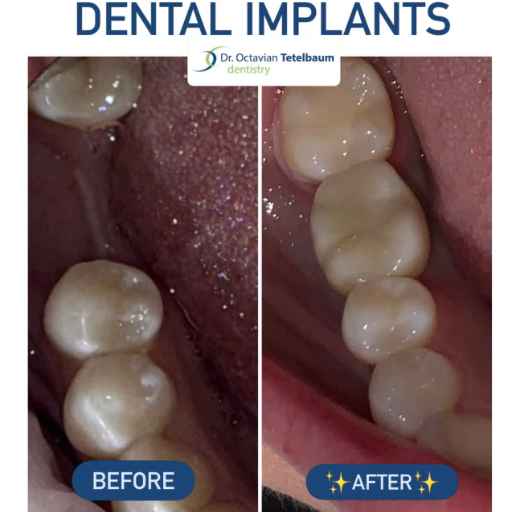
Dental Implants for Missing Teeth
A dental implant is a small implant placed into the jawbone to replace the root of a missing tooth. Once the implant has healed and integrated with the surrounding bone, it can support a dental crown, bridge, denture, or other restoration.
For a single missing tooth, an implant can support an individual crown. This provides a fixed replacement without requiring neighbouring healthy teeth to be reshaped to support a traditional bridge.
Dental implants can also be used when several teeth are missing. Depending on your needs, multiple implants may support an implant-supported bridge, partial denture, or full-arch restoration.
Dental Crowns for Damaged or Missing Teeth
A dental crown is a custom restoration designed to cover and protect a damaged or weakened tooth. Crowns may be recommended when a tooth has significant decay, a large filling, a fracture, or other structural damage.
A crown can also be attached to a dental implant to replace the visible portion of a missing tooth. In this situation, the implant replaces the tooth root while the crown restores the shape, appearance, and function of the tooth above the gumline.
The type of crown and restoration recommended will depend on the location of the tooth, its condition, your bite, and your individual treatment needs.
Dentures for Multiple Missing Teeth
Dentures are removable dental appliances used to replace missing teeth. A partial denture can replace several missing teeth when some natural teeth remain, while a complete denture can replace all of the teeth in an upper or lower arch.
Modern dentures are designed to restore chewing function and provide a natural-looking appearance. The fit and stability of a denture depend on factors including the shape of your gums and jawbone, the number of remaining teeth, and changes that occur after tooth loss.
For some patients, dental implants can be used to provide additional support for a denture. These restorations are commonly referred to as implant-supported dentures and may provide greater stability than a conventional removable denture.
Comparing Dental Implants, Crowns and Dentures
Different restorations are designed for different dental situations. Understanding the basic differences can help you discuss your options with your dentist.
| Treatment | Common Use | How It Works |
|---|---|---|
| Dental implant and crown | Replacing a single missing tooth | An implant replaces the tooth root and supports a custom crown. |
| Dental crown | Restoring a damaged or weakened tooth | A custom restoration covers and protects the existing tooth. |
| Dental bridge | Replacing one or more adjacent missing teeth | Replacement teeth are supported by natural teeth or dental implants. |
| Partial denture | Replacing several missing teeth | A removable appliance replaces missing teeth while fitting around remaining natural teeth. |
| Complete denture | Replacing all teeth in an upper or lower arch | A removable appliance replaces the teeth in an entire arch. |
| Implant-supported restoration | Replacing multiple or most missing teeth | Dental implants provide support for a bridge, denture, or full-arch restoration. |
Benefits of Dental Implants
For patients who are suitable candidates, dental implants can provide several advantages when replacing missing teeth:
- Fixed tooth replacement: An implant-supported restoration is secured in place rather than being removed like a conventional denture.
- Support for a replacement tooth: A dental implant can provide a stable foundation for an individual crown.
- Preservation of surrounding teeth: A single implant and crown does not require neighbouring healthy teeth to support the restoration.
- Replacement of multiple teeth: Multiple implants can be used to support bridges or other restorations when several teeth are missing.
- Support for the jawbone: Dental implants provide a tooth-root-like structure within the jaw and can help reduce the bone loss associated with tooth loss.
- Natural-looking restoration: Implant-supported crowns and other restorations can be designed to complement your existing teeth.
Are You a Candidate for Dental Implants?
Dental implants may be an option if you have one or more missing teeth and want a fixed restoration. Your eligibility depends on several factors, including the health of your gums, the condition of your remaining teeth, the amount of available jawbone, your bite, and your ability to maintain good oral hygiene.
Bone loss can occur after a tooth is lost. If there is not enough healthy bone available to support an implant, bone grafting or another preparatory procedure may sometimes be recommended before implant placement.
A comprehensive dental examination and appropriate imaging can help determine whether implants are suitable and which type of restoration would best meet your needs.
What Is the Dental Implant Process?
The dental implant process varies depending on the number of missing teeth, your oral health, the condition of your jawbone, and whether additional procedures are required. In general, treatment may include the following stages:
- Consultation and assessment: Your teeth, gums, jawbone, bite, and overall oral health are evaluated.
- Treatment planning: The implant position and final restoration are planned based on your individual needs.
- Implant placement: The dental implant is placed into the jawbone.
- Healing and integration: The implant is allowed to heal and integrate with the surrounding bone.
- Final restoration: A custom crown, bridge, denture, or other restoration is attached once the implant is ready.
The overall treatment timeline varies from patient to patient. Additional procedures, such as bone grafting, may require additional healing time before the final restoration can be completed.
Implant-Supported Dentures
Patients who have lost many or all of their teeth may have the option of combining dental implants with dentures. Implant-supported dentures use dental implants to provide additional support and stability for a removable denture.
Another option for some patients is a fixed full-arch restoration supported by multiple dental implants. The appropriate approach depends on the number of remaining teeth, the condition of your jawbone and gums, your bite, and your treatment goals.
Implant-supported dentures can be discussed as part of a broader treatment plan when conventional dentures do not provide the level of stability or function a patient is looking for.
Dental Implants vs. Dentures
Dental implants and dentures approach tooth replacement differently. Dental implants are placed into the jawbone and can support fixed or removable restorations, while conventional dentures rest on the gums and can be removed for cleaning.
For some patients, a conventional partial or complete denture may be appropriate. Others may benefit from dental implants or an implant-supported denture. The condition of your remaining teeth, gums, jawbone, and overall oral health should be considered before choosing a treatment.
Caring for Dental Implants, Crowns and Dentures
Good oral hygiene and regular dental examinations are important for maintaining your teeth and dental restorations.
Dental implants and crowns should be brushed and cleaned regularly, including around the gumline. If you have an implant-supported restoration, your dental team can show you how to clean around and underneath the restoration.
Conventional dentures should also be cleaned regularly and cared for according to your dental team's instructions. Regular dental visits allow your dentist to monitor your oral health, remaining teeth, gums, implants, and restorations.
Which Tooth Replacement Option Is Right for You?
There is no single restoration that is right for every patient. A dental implant and crown may be appropriate for a single missing tooth, while a bridge or partial denture may be considered when several teeth are missing. Complete dentures, implant-supported dentures, and full-arch implant restorations may be options when most or all teeth in an arch need to be replaced.
Dr. Octavian Tetelbaum can evaluate your individual situation and explain the available options, including the benefits, limitations, treatment process, and maintenance requirements of each restoration.
Restore Missing or Damaged Teeth
Missing or damaged teeth can affect chewing, speaking, your bite, and the appearance of your smile. Dental implants, crowns, bridges, and dentures can provide different ways to restore the function and appearance of your teeth.
If you are considering dental implants, a crown, dentures, or another tooth replacement option, book a consultation with Dr. Octavian Tetelbaum to discuss your needs and determine which treatment options may be appropriate for you.
Book Online
Synergy Dental offers the ability to request your dentist appointments online. Schedule an appointment now!
Book Online